
Europe’s technological future is increasingly defined by its ability to compute, simulate and model complexity at unprecedented scale. High-performance computing is no longer a niche capability reserved for specialised research environments; it is becoming a strategic pillar for scientific discovery, industrial innovation and digital sovereignty. In this context, the inauguration of JUPITER, Europe’s first exascale supercomputer, marks a defining step forward.
Driving forward several major quantum initiatives, we had the honor of attending the inauguration ceremony of Europe’s first exascale supercomputer JUPITER on 5 September last year. JUPITER is capable of performing an astonishing one quintillion (10²⁰) calculations per second—an extraordinary milestone in European high-performance computing. Held at Forschungszentrum Jülich, the event brought together distinguished guests from politics, science, and industry.
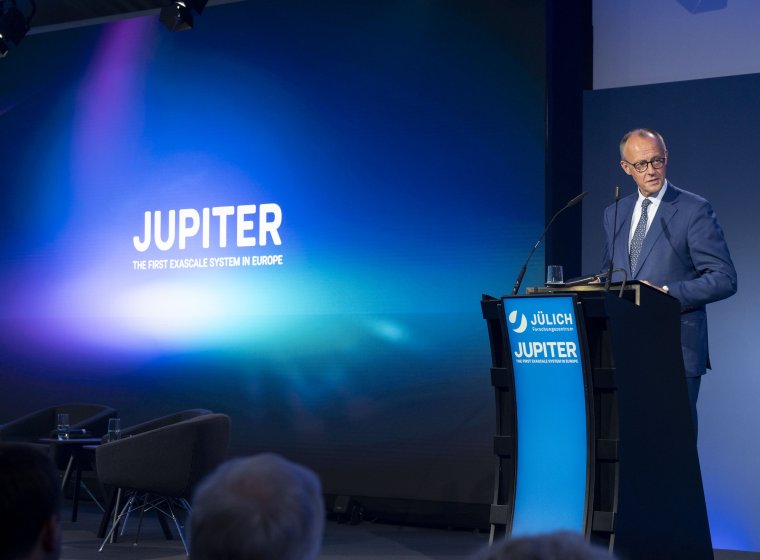
German Chancellor Friedrich Merz underlined JUPITER’s pivotal role in bolstering Europe’s AI competitiveness and digital sovereignty: “With JUPITER, Germany now has the fastest supercomputer in Europe and the fourth fastest in the world! It opens up completely new possibilities—from training AI models to scientific simulations. Our security and competitiveness in Germany and Europe depend on technological sovereignty and sovereign computing capacities. Strengthening Germany as a technology hub is therefore one of the Federal Government’s top priorities. JUPITER and the excellent research work at Forschungszentrum Jülich prove that Germany can set new standards in the research, development, and application of future technologies—and contribute to solving the challenges facing humanity.“
Henna Virkkunen, Executive Vice-President of the European Commission for Technological Sovereignty, Security, and Democracy also acknowledged JUPITER’s historical importance for enhancing Europe’s supercomputing capabilities: “This is a historic milestone. With JUPITER, Europe is reaching the highest level of high-performance computing. JUPITER is also a testimony for Germany's long leadership in HPC. Today, it became the home of the most powerful computer in Europe and the fourth most powerful in the world. From European perspective, JUPITER is a pioneer. It shows that when we combine national vision with European cooperation, we can achieve global excellence.“

JUPITER AI Factory: Supercomputing Meets AI Innovation
JUPITER is also at the heart of the JUPITER AI Factory (JAIF), currently under development in Jülich, which represents a cornerstone of Europe’s emerging AI ecosystem. Together with JAIF, JUPITER will extend its impact well beyond research and the public sector, offering access to start-ups, small and medium-sized enterprises, and industry.
To this end, an additional module tailored specifically for inference applications is in preparation. This planned cloud platform will seamlessly complement the JUPITER infrastructure, enabling the rapid and efficient deployment of trained AI models in real-world use cases.

Shaping Europe’s Quantum Future Together
As EURICE Group, we place great value on our long-standing collaboration with Forschungszentrum Jülich, particularly within the frameworks of our running initiatives HPCQS, OpenSuperQPlus, and QSolid. These projects have established a strong foundation for advancing research in high-performance and quantum computing. The inauguration of JUPITER marks a transformative milestone, unlocking unprecedented computational power and scalability.
Alongside the launch of JAIF, these initiatives form part of a dynamic quantum innovation ecosystem that positions Europe at the forefront of AI and supercomputing. We are proud to contribute to this momentum and eager to continue shaping Europe’s quantum future together.
Read more about JUPITER here.