 Industrial Technologies
INERRANT
Revolutionising Lithium-ion Battery Technology for Enhanced Safety

At a Glance
- Developing safer and more sustainable Gen3 lithium-ion batteries (LIBs)
- Pushing the boundaries of current LIB technologies by developing innovative material combinations and optimising the four key components of a LIB cell: anode, cathode, separator, and electrolyte
- Paving the way for a future where mobility is both eco-friendly and secure

Boosting Battery Safety
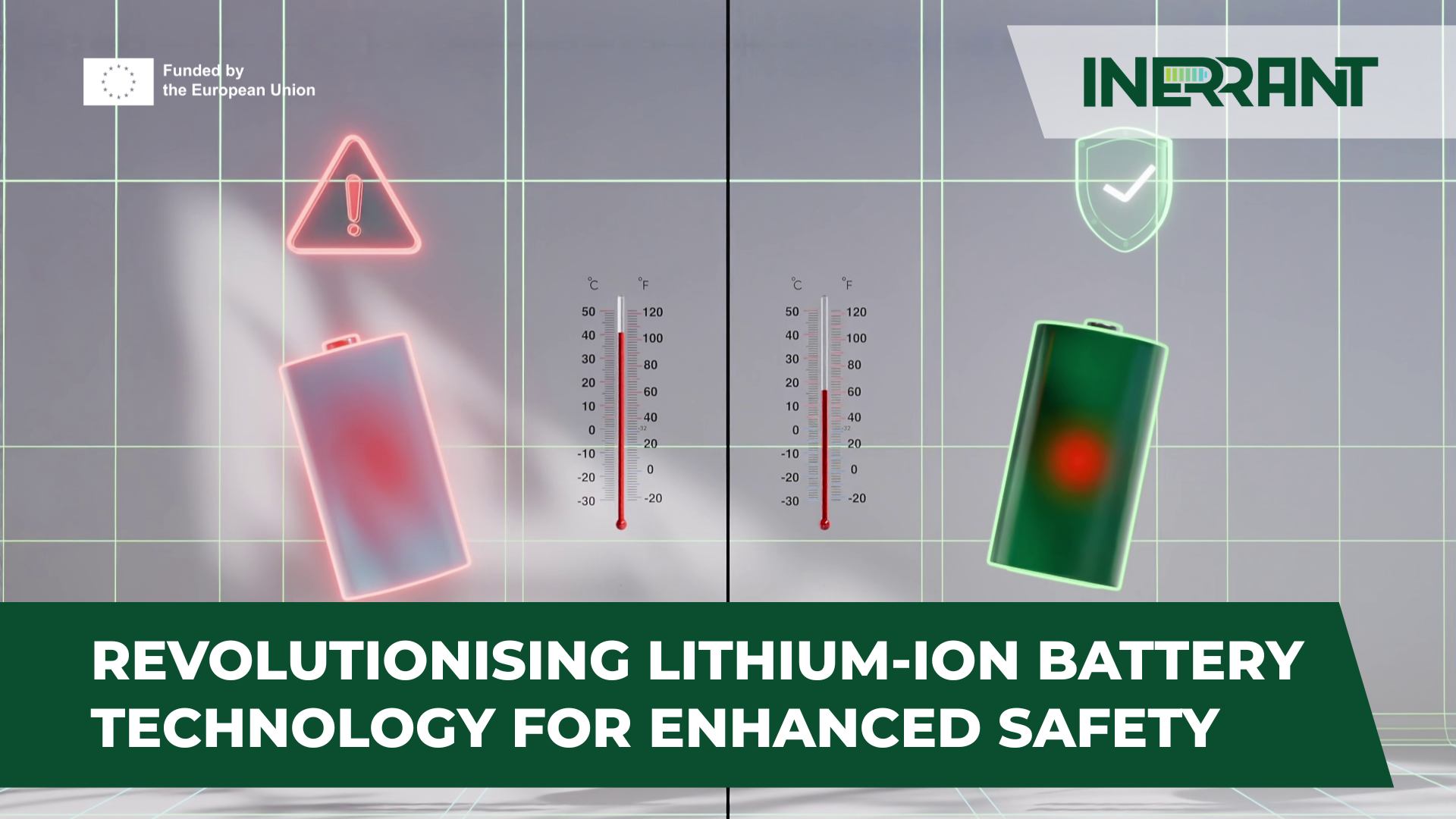
As the demand for e-mobility, renewable energy storage, and portable electronics rises, existing LIB technologies face critical limitations, such as safety risks, performance degradation, and reliance on critical raw materials. Moreover, with the continuous improvement in energy density of batteries, ensuring battery safety becomes indispensable to prevent unintended energy release and thermal runaway. Thermal runaway happens when a battery overheats, causing a chain reaction that quickly accelerates temperature and can lead to fire or explosion.
This is why INERRANT develops internal protection methods using smart separator designs that prevent the battery from operating when overheating risks arise. By protecting key components from damage INERRANT’s new battery designs improve both the safety and lifespan of LIBs. However, the goal is not just to enhance performance but also to reduce environmental impact and strengthen Europe’s energy independence and transition to a climate-neutral, circular economy.
From Materials to Recycling: A Holistic Approach
To achieve its ambitious goals INERRANT addresses the entire battery lifecycle – from design through end-of-life – advancing the next-generation lithium-ion batteries through a holistic approach. The project focuses on four key areas: innovative electrode materials, smart separators, responsive electrolytes, and eco-friendly recycling. By developing novel (nano)material combinations for anodes and cathodes, INERRANT aims to boost energy density and reduce reliance on critical raw materials. Smart separator structures act as internal safety mechanisms, preventing thermal runaway by shutting down the battery in case of overheating.
At the same time, adaptive electrolytes respond to stress conditions, reducing degradation and extending battery life. To close the loop, INERRANT designs sustainable recycling methods that recover high-purity materials. The project’s holistic lifecycle strategy ensures that materials and processes are safe, sustainable, and reduces the dependence on critical raw materials, while assuring the technologies are scalable and industry ready.
INERRANT takes a holistic view on the battery lifecycle, from design and production to end-of-life, and thus paves the way for safer energy storage solutions.
Curious to know more?
Let's start the conversation.
Your contact

Sam Hoefman
Senior Research & Impact Manager
Portfolio Manager Industrial Technologies
Portfolio Manager Industrial Technologies